
Two teams win SPJ’s first-ever research grant.

By Michael Koretzky
SPJ ethics chair
If you don’t learn ethics in college, you probably won’t learn them on the job. In fact, you could easily learn the opposite.
That’s why SPJ is debuting a $2,500 College Research Grant for Journalism Ethics during Ethics Week. But we couldn’t choose just one winner from among the seven proposals we received. So we split the money between two teams.
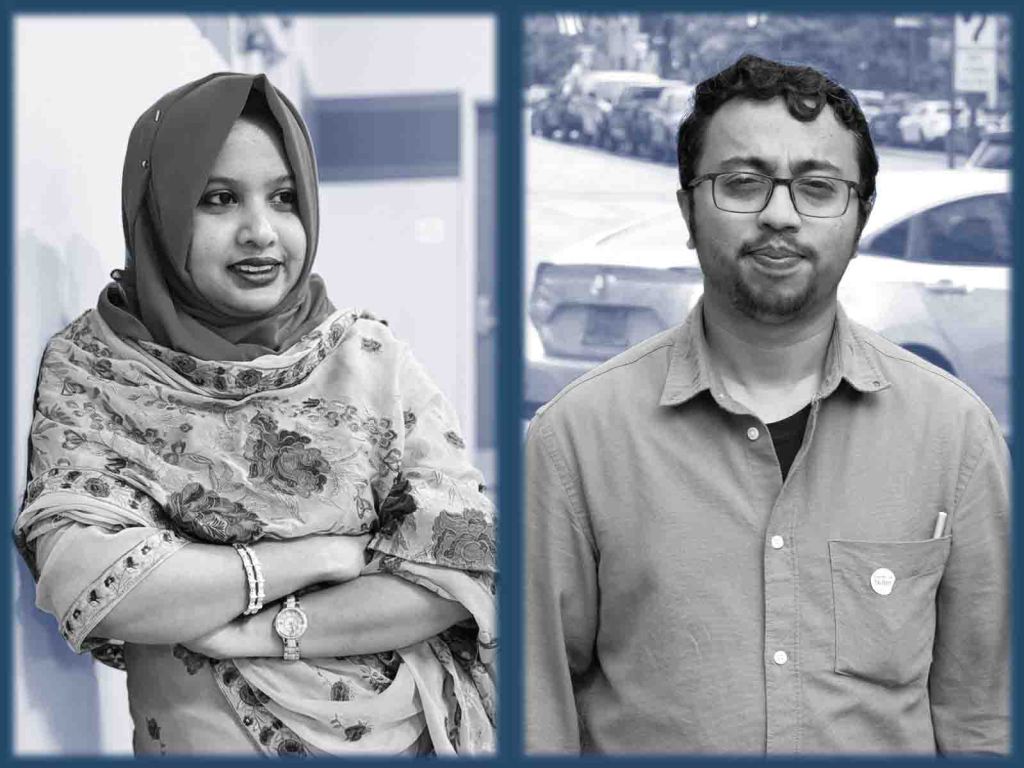
Wahida and Ahmed Alam
Wahida is doctoral student at the the University of Missouri j-school. Ahmed is doctoral candidate at University of Oklahoma’s Gaylord College of Journalism and Mass Communication. The couple has been married three years, and before they celebrate their fourth anniversary, they’ll be “exploring how AI tools are being incorporated into student-run newsrooms and their impact on ethical journalism.”
Their research objectives…
- “To compare past and present ethical guidelines and decision-making frameworks in student media.”
- “To evaluate the extent to which AI is integrated into student journalism and its impact on ethical reporting.”
- “To assess student journalists’ perceptions of AI’s role in maintaining journalistic independence, integrity and transparency.”
Added Wahida…
We felt the results from this study would help the student journalists as well as their instructors and the journalism scholarship. We think college media students are welcoming newer technologies for journalistic activities but are still emphasizing established ethical principles of journalism like truth-telling, minimizing harm, among other things. However, these college media students may also possess different standards of transparency and integrity than previous generations as they see a potential in the use of tools like AI to disseminate information among readers in the news deserts.

David Bostwick, Gina Shelton, Susannah Swearingen, Bobbie Foster
David Bostwick is associate director at the University of Arkansas j-school, and he had a simple yet clever idea: “Study whether there are differences in perceptions of professional ethics” between journalism major and advertising/PR majors.
Obviously, splitting a $2,500 grant means Bostwick’s team can’t do this nationally. So they’re thinking locally. As Bostwick explains…
The preamble to the SPJ Code of Ethics emphasizes how the four principles can be used by “all people in all media,” not just traditional newsroom journalists. Our school has approximately twice as many ADPR majors as we did four years ago. Rather than making anecdotal observations about how this trend impacts the way we teach our ethics courses, our research team wants to collect data comparing attitudes among journalism majors, ADPR majors, student-media participants and academic levels.
But this isn’t just about the University of Arkansas.
“Beyond our campus, our research could benefit other media programs, especially those that are broadening their application of journalism ethics as applied to advertising and public relations,” Bostwick says. “For example, other colleges could easily replicate portions of our work to evaluate the ethical landscape among their own students.”
Will SPJ continue to fund ethics research? I suppose that depends on the results that these two teams come up with.

 SPJ Ethics